Filmed Without Consent in Korea: Your Legal Options, Even After You Leave
If you were secretly filmed in Korea, leaving the country does not end your case. Here is what the law actually allows.
Not legal advice. This is general information, not legal advice. It does not create an attorney-client relationship.
Key facts
- Many victims believe that once they leave Korea, their case is effectively over — it isn't.
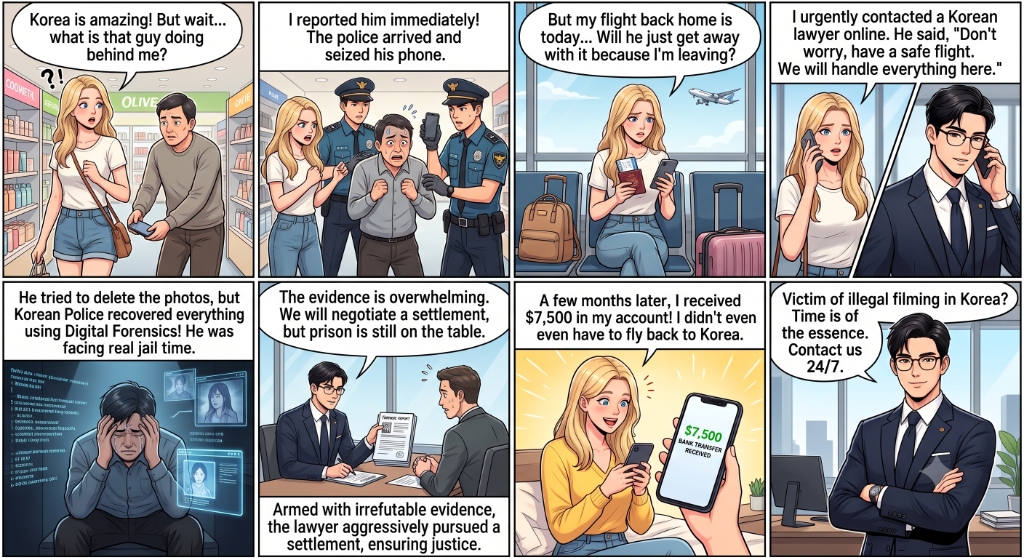
- By retaining a licensed Korean attorney and granting a power of attorney, you can fully maintain the criminal complaint and settlement process from abroad. Once your initial statement is secured by the police, all subsequent stages — including investigation, prosecution, court trials, and settlement negotiations — can proceed to 100% completion without you ever having to re-enter Korea.
- A retained Korean attorney can continue building the case, negotiate a settlement, and represent your interests while you are abroad.
What Korean law actually says
Under Article 14 of the Act on Special Cases Concerning the Punishment, etc. of Sexual Crimes (Camera-based Filming), filming another person's body against their will is strictly prohibited. Furthermore, following the May 2020 amendments, the law has been expanded to penalize not only those who take or distribute illicit footage, but also anyone who knowingly possesses, purchases, saves, or views such illegal recordings.
Violators face up to 7 years in prison or a fine of up to 50 million KRW. The legal penalties escalate significantly under aggravating factors, such as distribution for profit (which carries a minimum of 3 years in prison), habitual offenses (which can increase the sentence by half), cases involving multiple victims, or prolonged repetitive behavior.
The two tracks: criminal case and settlement
In Korea, criminal prosecution and civil compensation operate on separate legal tracks. However, in practice, a criminal settlement (known as 'Habi') functions as a powerful tool where the perpetrator pays compensation to the victim in exchange for a 'non-punishment letter' (Cheobeol-bul-won-seo) to avoid jail time. Many foreign victims are unaware that this custom exists or how crucially it impacts the court's sentencing decision.
Settlement negotiations are typically initiated by the offender's defense counsel when their client faces a high risk of imprisonment, usually during the late stages of police investigation or before the court trial. The victim's attorney acts as a crucial barrier and negotiator, handling all communications privately to shield the victim from intimidation while maximizing the compensation through strategic leverage.
What you can actually recover
In practice, for camera-based crimes where the footage has not been leaked or distributed, settlement amounts typically range between 5 million KRW and 15 million KRW. Rather than a fixed figure, the final amount depends heavily on the offender's financial capacity, social status, and their level of desperation to avoid incarceration — particularly if they face habitual offense charges or are in danger of losing their livelihood.
You can proceed after leaving Korea
A retained attorney files and maintains the complaint on your behalf using a formal Power of Attorney (POA), bypassing the need for your physical presence. The attorney coordinates remotely with police and prosecutors, submits supplemental briefs, and manages all administrative steps. While an initial statement at a Korean police station prior to departure is highly recommended to secure the case, subsequent statements can often be supplemented in writing or through video interviews if necessary.
Before you leave Korea: evidence to preserve in the next 48 hours
- Report the incident immediately to store staff or security guards rather than confronting the offender directly. This ensures local CCTV footage is secured and the police can be dispatched to seize the offender's phone on the spot.
- File an initial police report and provide your victim statement at the nearest police station or transport police unit before you board your flight. This allows investigators to initiate mandatory forensic tracking immediately.
- Collect contact details of any eyewitnesses, including your own family, friends, or travel companions. In Korean courts, testimonies from your accompanying group are recognized as strong corroborative evidence.
- Write down a detailed description of the perpetrator's appearance, the exact timeline, and your immediate emotional distress while your memory is fresh. This prevents the offender from using inconsistencies in your later testimony to escape charges.
- Retain a Korean attorney as early as possible. Having legal representation before departure allows your lawyer to accompany you to the police interview and immediately request a digital forensic analysis of the seized device.
What you may be able to recover
Criminal settlement (합의금)
5,000,000 KRW to 15,000,000 KRW (approx. $3,700 to $11,000 USD)
Negotiated based on the offender's financial status, career risk, and legal urgency. A signed settlement dramatically reduces the offender's criminal sentence, which gives you significant negotiating leverage.
Civil damages claim
Varies; typically pursued if criminal settlement fails or the offender refuses to cooperate.
A separate civil lawsuit is highly effective once the offender is criminally convicted, as the criminal verdict serves as irrefutable evidence of liability to seize their assets.
Counseling / psychological support costs
Fully recoverable under both criminal settlement negotiations and civil claims if properly documented.
Must present medical certificates, therapist invoices, or pharmacy receipts. Medical records from your home country are fully accepted as evidence if translated.
Quick answers
Can I still file a complaint if I've already left Korea?
Yes. You can file a complaint through a legal representative at any time within the statute of limitations. However, because local surveillance (CCTV) footage is typically overwritten within 15 to 30 days, it is critical to act quickly so your attorney can preserve the digital evidence.
Do I need to come back to Korea for a trial or to receive a settlement?
No. Your attorney can manage all negotiations, receive the settlement funds on your behalf, and wire them safely to your bank account abroad. The entire process can be completed 100% remotely.
How long do I have to act after the incident?
While the legal statute of limitations spans several years, the practical window is much smaller. You should act within 15 days of the incident, as crucial security footage from retail stores, subways, or streets is deleted permanently after this period.
Reviewed by
Attorney at Law, licensed in the Republic of Korea
Bubshin Law Firm
Have a follow-up question?
This page is general information, not a case evaluation. If something here doesn't match your situation, leave a question and email — a real person in Korea will get back to you with a general pointer, not legal representation.