Not legal advice. This is general information, not legal advice. It does not create an attorney-client relationship.
Key facts
- South Korea enforces strict Zero-Tolerance laws under the Narcotics Control Act (마약류 관리에 관한 법률). Legal status in your home country (e.g., US, Canada, Thailand, Europe) is completely irrelevant under Korean territorial jurisdiction.
- Bringing CBD oil, delta-8 gummies, hemp edibles, or cannabis flower through Incheon Airport Customs (인천공항 세관) triggers an immediate criminal investigation by airport customs police and prosecutors.
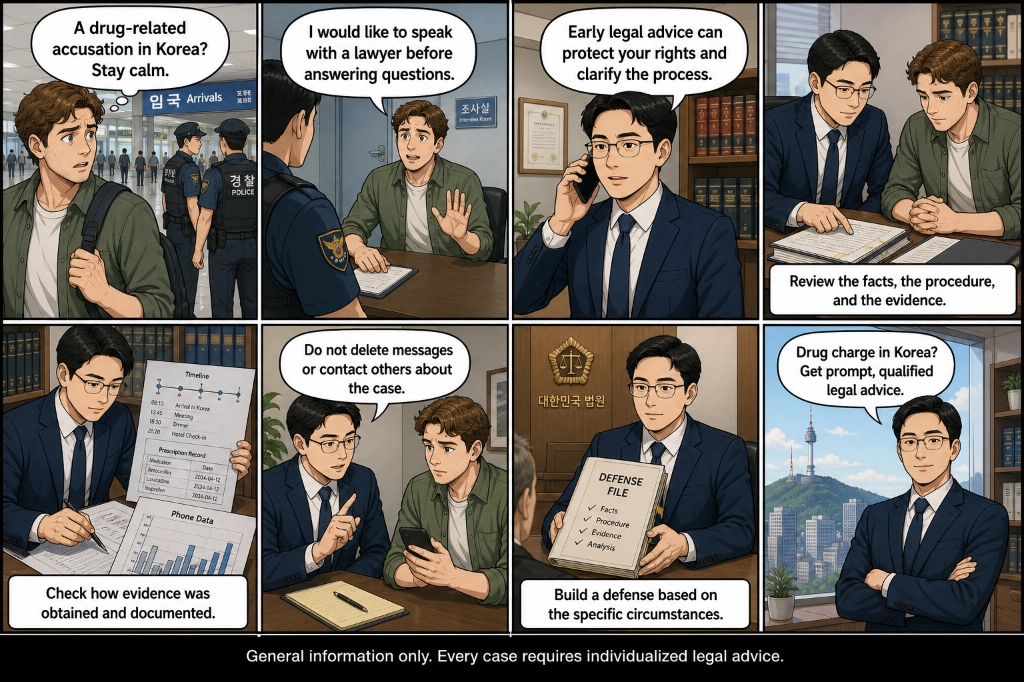
- Retaining a licensed Korean criminal defense attorney before your initial interrogation is critical to reframe felony smuggling charges into unintentional personal possession, prevent pre-trial detention, and avoid mandatory deportation.
Strict Zero-Tolerance Under Korea's Narcotics Control Act
Under Article 58 and Article 61 of South Korea's Narcotics Control Act, all forms of cannabis—including over-the-counter CBD oils, medical gummies, vape cartridges, and THC edibles—are strictly classified as illegal controlled narcotics. Korean law operates under strict territorial jurisdiction (속지주의), meaning any foreign national entering Korean territory is fully subject to Korean criminal law.
Crucially, Korean prosecutors do not distinguish between recreationally purchased marijuana and over-the-counter wellness products bought legally abroad. Carrying even trace amounts of Tetrahydrocannabinol (THC) or Cannabidiol (CBD) through airport customs constitutes a serious criminal offense.
Interrogation at Incheon Airport & Pre-Trial Detention Risks
When Incheon Airport Customs inspectors flag baggage containing suspicious items, the passenger is immediately escorted to an airport interrogation room. Customs officers seize the items, issue a travel departure restriction, and conduct mandatory forensic urine and hair drug testing.
Initial statements made to customs officers during this high-stress period are transcribed into official investigation protocols (피의자신문조서). Unguided statements—such as admitting you packed the items yourself without realizing they contained CBD—are frequently interpreted by prosecutors as confession of intentional narcotics smuggling, severely damaging your legal defense.
Smuggling vs. Accidental Personal Possession: Reframing Charges
By default, customs authorities initially file charges under 'Importation/Smuggling of Narcotics' (마약류 밀반입), which carries severe statutory penalties ranging from 5 years imprisonment to life in prison. This is vastly different from simple possession charges.
An experienced Korean defense attorney acts immediately to submit medical documentation, overseas purchase receipts, and legal briefs to reframe the incident. By establishing that the item was an accidental, non-commercial purchase intended solely for personal wellness or pain relief, your attorney can downgrade charges from felony smuggling to simple unintentional import or possession.
Immigration Penalties: Immigration Entry Bans & Deportation (출국명령)
For foreign nationals in Korea, criminal defense is inseparable from immigration defense. Under Article 11 and Article 46 of the Korean Immigration Act, any foreign national convicted of a narcotics crime or fined ₩5 million or more faces mandatory deportation (강제퇴거 or 출국명령) and a 5 to 10-year ban on re-entering South Korea.
The primary goal of legal defense is to secure a Deferred Prosecution (기소유예) or a suspended sentence below the immigration threshold. A retained Korean attorney handles both the criminal investigation and subsequent Immigration Service (출입국·외국인청) hearings to protect your visa status or minimize travel restrictions.
Immediate action checklist if detained or investigated at Korean Customs
- Do not sign formal confession protocols or answer detailed intent questions without an official interpreter and your legal counsel present.
- Exercise your constitutional right to retain a licensed Korean criminal defense attorney immediately upon customs detention or summons.
- Gather overseas purchase receipts, medical prescriptions, and travel itineraries to prove the product was bought legally abroad for personal use.
- Allow your attorney to represent you during mandatory forensic drug testing (urine/hair analysis) and prosecutor interviews.
- Submit a formal legal defense brief to reframe felony smuggling charges (min 5 years) to simple unintentional possession.
- Coordinate with your defense attorney to manage Immigration Service (출입국 사범심사) procedures to prevent entry bans and forced deportation.
Key defense objectives & legal outcomes
Deferred Prosecution (기소유예)
Optimal defense outcome; complete dismissal of formal indictment
The prosecutor acknowledges the violation but declines to file formal criminal charges. Preserves a clean record and significantly reduces immigration deportation risks.
Reclassification to Unintentional Personal Possession
Reduces statutory penalty from 5+ years imprisonment to fine or probation
Replaces felony smuggling charges with minor possession/import, establishing that the item was for personal wellness without commercial intent.
Suspended Sentence (집행유예) & Immigration Mitigation
Avoids physical incarceration in Korean prison
Allows the individual to avoid prison time and coordinates with the Immigration Office for orderly departure without prolonged detention.
Quick answers
CBD gummies and oil are legal in my country. Why am I charged in Korea?
Korean law applies territorially to all persons within Korean borders. South Korea's Narcotics Control Act does not recognize foreign legalizations or over-the-counter status of CBD/THC products.
Will I be arrested and sent to a Korean prison immediately at the airport?
For small personal quantities without flight risk, prosecutors may issue an Exit Ban (출국금지) and investigate without physical detention. However, larger quantities or suspected commercial intent lead to formal arrest warrant applications.
Can I leave Korea while the customs investigation is ongoing?
Authorities usually place an Exit Ban on suspects. Your retained attorney works with prosecutors to expedite investigations or request lifting of exit bans through proper legal representation.
Reviewed by
Attorney at Law, licensed in the Republic of Korea
Bubshin Law Firm